Gold Hill (Burro Mountains)
Deposit type & geology
Precambrian granite-hosted quartz-pyrite veins.
Neoproterozoic Bullard Peak Series gneiss/granite (~1.46 Ga).
Age: Vein age uncertain — NMBGMR's own 1940 synthesis cautions some “Precambrian” veins in NM may actually be younger, reactivated structures.
Structural geology & terrain
Vein/structure orientation: Veins at granite/mafic-rock contacts; Standard Mine WNW/45°SW
Named controlling structure: Malone fault (NE boundary of the Gold Hill structural block)
Elevation range: ~6,152 ft; peak 8,035 ft
Madrean lower montane woodland; relatively good access, surrounded by population centers.
High-resolution terrain
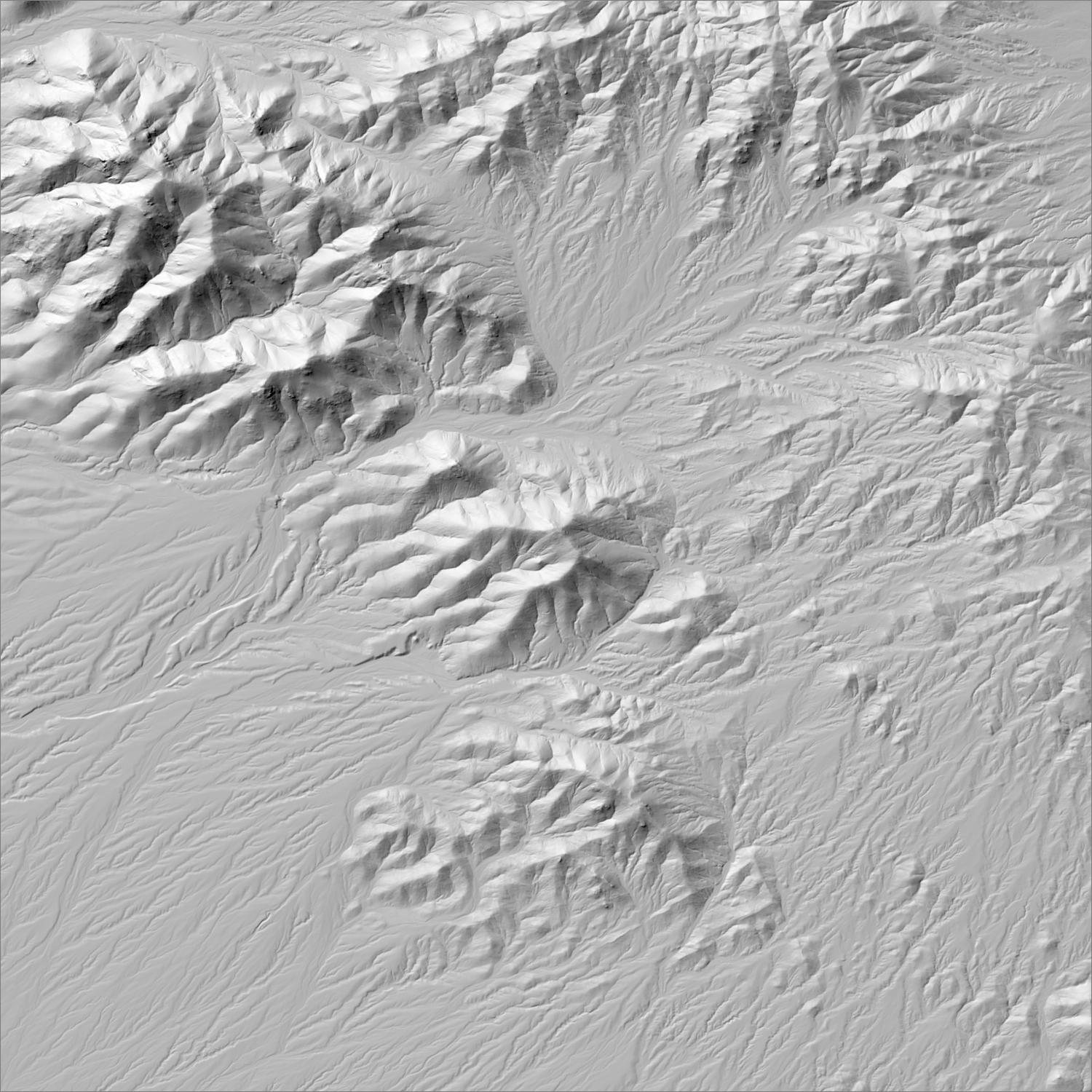
~6 m/pixel lidar-derived hillshade (USGS 3DEP) — fine enough to reveal old mine workings, waste-rock piles, trenches, and roads the statewide terrain layer can’t show.
Historical production
Not quantified in ounces by any source found; two stamp mills processed $15–40/ton ore until oxidized-ore exhaustion (NMBGMR Circular 5). Associated placer yielded <100 oz.
Sources: NMBGMR Circular 5; USGS MRDS (Standard Mine); EMNRD AML Gold Hill Mine Safeguard Project file; USGS Misc. Field Studies Map 1035 researched — see sources
Current status
Reclaimed. The Gold Hill Mine Safeguard Project (EMNRD Abandoned Mine Land Program, 2005–06) backfilled 26 features and installed bat gates across 14 historic sites. No current mining or exploration activity identified.
Dormant — no recent activity
The EMNRD Abandoned Mine Land Gold Hill Mine Safeguard Project completed backfilling and bat-gating in 2005–06; no claims since.
Land ownership & directions
U.S. Forest Service land — open to mineral entry under the 1872 Mining Law, but surface use is regulated by the Forest Service and may include wilderness-adjacent or sensitive-area restrictions.
Gila National Forest, Grant/Hidalgo county line. ~10–16 mi NE of Lordsburg.
See specimen photos (mindat.org) → — this app doesn’t host specimen photos itself; this searches mindat.org’s own mineral-specimen database, which isn’t necessarily specific to this exact district.
This pin is a generalized district/historic-site reference point, not a surveyed claim boundary — routes may cross private or patented inholdings where public access isn’t guaranteed even if a road reaches the site. Backcountry mine areas commonly have unmarked shafts, unstable ground, and no cell service; confirm current access and safety conditions (land manager, county, or landowner) before heading out.
Tailings reprocessing potential
Two stamp mills processed oxidized ore "until apparent exhaustion" (NMBGMR Circular 5) — phrasing that suggests the mills were reasonably effective on the ore they ran, with remaining value more likely in unmined refractory ore at depth than in the tailings themselves.
This is a documentary heuristic, not assay data.The tier above is inferred from historic production era, processing method, and ore character already cited elsewhere on this page — nobody has sampled or assayed this district’s tailings as part of this research. Actual recoverable gold content can only be established by physical sampling.
Reprocessing tailings is regulated mining. Disturbing or reprocessing historic mill waste requires the same NM Mining Act permitting as new mining (see the regulatory companion guide), regardless of who currently holds the claim or surface rights — and ownership of the tailings material itself is a separate legal question from mineral rights on the underlying land.
Legacy tailings can be hazardous. Pre-modern processing commonly used mercury (amalgamation) or cyanide (heap leach), and can carry elevated arsenic and other heavy metals — not a casual sampling target, and disturbing contaminated material can carry real environmental liability.
Geologist’s read
One of the few genuinely Precambrian-hosted gold occurrences in the state — but NMBGMR's own literature is explicit that New Mexico has no major, well-documented orogenic Precambrian gold province; occurrences like this are real but consistently small and secondary to the state's dominant Tertiary systems.